
This conversational piece, made me want to slide into the conversation, to respond.
The closing, Arielle's own quiet postscript, was so beautiful and heartbreaking. As I lay next to my son, watched his little huffs of breath, thought of the beauty that Arielle gave Day--that natural birth, that time--it moves me.
So if I could, here is what I might have inserted:
Somewhere in the text, I would have pointed out how strange it is that having a homebirth can be an act of privilege too--how strange it was for women in NYC to think, "Couldn't you afford a doctor?" when R spoke of her homebirth. In that strange twist, homebirth wasn't an insurable option for me, and we couldn't afford to pay for it ourselves. (O fertility treatments...) What I wish: that women could feel positive about their birth stories and that they could have more choice in the choice-matters. Like where. My own husband didn't feel comfortable with a homebirth, and I made peace with that. He is part of this. He was, besides the babies that resulted, the absolute best part of my birth stories.
I am mostly scared of being sectioned. (11)
This is where I knew the text would hum and become electric for me. I never even thought-- And here I am, twice sectioned. That word! Section. Divided in half, there on the table.
You could have. You were amazing. Watching you changed my life. (19)
My heart felt nice here. I admire these two women so much. My heart felt nice, warm. I wonder what it might have been like if we put a tub in our home, if O. was a doula already. What might have been different.
At the Q&A for the benefit screening, a postpartum nurse said she so admired the post-op moms limping down the halls, dragging their IVs, coming to try to nurse their babies. "It's heroic really, and much harder than you might think."
I couldn't even walk after mine. Not for--what, twenty-four hours? Ryan carried me and I lugged behind like a doll. The second time, I convinced the nurses that they should take the catheter out; I was so desperate to convince them to send me home. Walking from the bed to the bathroom gave me howling pain. But nursing Finn? He was right there in bed with me, as was Maya. No problem there.
Abby wants more than three. She has one fallopian tube left and a uterus covered in scar tissue, but she is trying. (29)
Wait. Wait. I hadn't even thought of this. I already have so much going against me, and now, two scars. I'd loved the one on the outside so much; the one on the inside, such an unfriendly place to latch. I've been hoping for a third.
My water broke at the beginning of labor. Our midwives in Main this time said, 'We would want to know why your water bag broke. We would fix that with nutrition. This time that won't happen first." (33)
Let me go back. Let me eat my way into a different labor. I'll eat nothing but kale, straight from the dirt. This conversation makes me feel desperate, looking back.
You said, 'It seems cruel now to make women birth on land. And I said, 'That's what I said to you.'
Yes.
For my birthday this year you got me homebirthing, lactivist comic books by a feminist artist who calls herself Hathor, after the Egyption goddess of fertility, women, children, midwives, and childbirth.
I wrote about about Diana. I wear oak leaves in my hair.
Following Queen Victoria's life-long mourning of her own children, the Victorians made an art of memorializing and keeping close their dead, in the form of jewelry, crafts, and photographs. Secure the shadow. (53)
Sue made tchotchkes from the flowers at Jim's funeral. I have a bookmark; the boys got keychains. I mistake them sometimes for the ashes. I think of the tattoos that have been done with pet's ashes. Gatsby sits on a bookshelf.
Ilana said, 'Never use the expression 'rule of thumb.' It comes from an old English law that allowed a man to beat his wife with a stick as long as it was no thicker than his thumb. (87)
I think of switches. Of the way willows dissolve into fight.
In a herd, the female elephants form a circle around the elephant who is laboring and hold the space while she births. They don't intervene in any way; they are the doulas. (98)
Hold the space. Like breath.
It's my theory that a lot of postpartum depression, which they say is at near-epidemic proportions in this country, can be accounted for by traumatic or even mediocre hospital births, where women feel disempowered or separated from their experience and their baby. (100-101)
Failure to progress. F A I L .
Then the Morningstar midwives said, 'Drinking that stuff is like drinking fourteen Blizzards from Dairy Queen in a row. There are better ways to tell if you have gestational diabetes.' (105)
Give me another way. Or give me the ice cream.
I think of Hoa's story: sending her husband and son out for errands, baking bread, humming into her contractions, and then when they got home she slipped the baby out, her second boy. (111)
More. Tell us all of the stories.
Another problem for me is that while I agree with so much of what he said, Dr. Grantly Dick-Read was no feminist. He said, 'Woman fails when she ceases to desire the children for which she was primarily made. Her true emancipation lies in freedom to fulfill her biological purpose, to satisfy her physiological demand.' (135)
I couldn't look past this. How can anyone look past this? Yes, pro-homebirth, but not every woman. This needs to be OK too.
Do you know how they keep the internal fetal monitor inside the mother? They screw it into the baby's skull. (161)
Maya came out with a gouge. I didn't know what it was for so long, thought it might have been from her arrival into the air, some instrument.
At the screening of The Business of Being Born we attended in Chicago, everyone in the homebirth-advocate-heavy audience cried and exclaimed with joy at the homebirth scenes, no matter how graphic, and booed and winced and covered their eyes at the hospital scenes. I thought, This is the right reaction. And I wondered, Would it be the opposite reaction if this was shown to a mainstream American audience? (173)
I can't answer this. I haven't seen it yet. Am I afraid? I would whoop and cheer at any woman happy with her birth narrative. Could mine have ever been content? Is my biology unfit for delivery? I would whoop at any woman who had all the knowledge and felt empowered.
After my homebirth with Judah I didn't need to write a poem. I didn't need to fix anything. (175)
I cried at this. I cried. Yes. I am writing my way out of this.
Showing posts with label bookshelf. Show all posts
Showing posts with label bookshelf. Show all posts
Saturday, February 1, 2014

Monday, May 27, 2013
what i've been reading lately

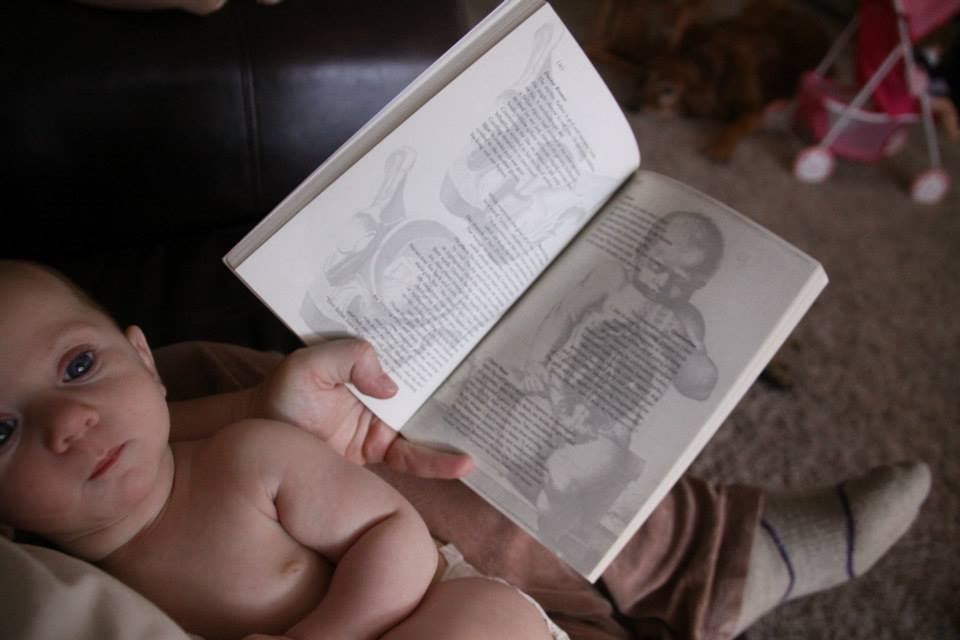
(Finnegan, three months.)
In graduate school, of which Sarah Fox (below, her book First Flag) was a peer, I gained, over three years, insight into contemporary poetic movements. I think, before, I read what I liked, and I was highly influenced by my first true professor of poetry, Michael Dennis Browne. From him, I learned to love Anna Akhmatova, James Wright, Elizabeth Bishop, Pablo Neruda, Jane Kenyon and Donald Hall. I came into his classroom loving Sharon Olds, Carolyn Forche. Of course, Plath and Sexton. William Carlos Williams. Li-Young Lee. Poets with deft use of narrative and image. Many uses of the self, of lovers and family, not always confessional, but certainly personal.
So when I met my cohort and the one following mine, I also learned many new names: Chelsey Minnis, the Gurlesque, Mei-Mei Berssenbrugge, Alice Fulton and Alice Notley. I had trouble reading Hiromi Ito's Killing Kanoko, though I wouldn't mind giving it a second chance. SF had a good conversation about it on Rain Taxi. I scrunched my brow at some of the poems that crossed my desk in workshop, read Montevidayo and wondered why I wasn't entering this new poetics as gleefully as I might have years ago: was I too stodgy? Did my preference for the elegant, the image, the story preclude me from appreciating the flashy, the grotesque?
There were words I struggled to separate: experimental versus avante garde versus conceptual versus postmodern. Where did they intercede, intersect, overlap, snuggle with one another in a messy heap?
I'd learned that I loved the hybrid poem-essay. I read Claudia Rankine's Don't Let Me Be Lonely and swooned. At AWP in Denver, I borrowed my friend's copy of Bhanu Kapil's Humanimal and wanted to immediately read it again.
Not long after, my dear friend Opal published her thesis essay, re-visioned: Surge: An Oral Poetics. I swooned and read it again and licked my fingers when I was done.
I was beginning to understand my tastes, how all of this box-making I was doing was preventing from me letting my own convergence occur. I love the elegant and the liquid. I love the lineated and the great scramble. I love images still, yes, and I love powerfulness (I nearly wrote power, but that's not quite right) and confidence and the ability to be humble and blushes and passion and the exact right word and verbs and breath. And breath.

Recently, a convergence of reading, along with a good discussion with my dear friend Meryl about these labels and, essentially, the goals of some of the movements, allowed me to read and begin to fall in love.
It's so strange, because I didn't understand much of what was popular for my peers, which made me feel a bit on the outside of things, but I always knew and wanted to find my place in it. And I have been getting walloped by falling in love with poetry lately: Love, An Index and The Lifting Dress and At the Drive-In Volcano and Exit, Civilian in a row and SWOON, but I would have swooned a decade ago too. This swoon isn't new to me, even if it feels that way when I do so. And then: pieces of Lidia Yuknavitch's The Chronology of Water; and Christine Hume's Ventifacts (which I read on a delightfully windy day at the park), which became the model for much of what my own hybrid-thing has become; and then a package from Noemi Press arrived with Danielle Pafunda's Iatrogenic, and I thought, Those poems, I wrote some like that during my infertility treatments and early pregnancy, exactly.like.that; and Sarah Vap's The End of Sentimentality, which went ahead and finished me off, a poem-essay that bandies the words irony and sentimentality (and easy and difficult) around and helped me deal with the use of certain language in order to convey meaning. Confront what had been discomfort and translate it to experience, meaning beyond our typical associations. Not reclaiming the word. That's been done. But rewriting.
I'm glad these things have cracked this part of my reading-life open. I wanted the doors to open.
Saturday, April 13, 2013
bookshelf: two minutes of light by nancy k pearson
reeling in small loaves / of sunlight (3)
a field of birds-- / black wings breaking a sure hunk of sky / into a thousand parts (3)
only muscle scars where the fruit once hinged (5)
When he hit the water, / his backbones tangled like water root. (28)
I hold on / to a small tangerine, I unwrap the orange collars (29)
glassy nap (34)
the moon orphans all those stars (40)
the sea is / a white forest of lungs (45)
the engagement of gliding tendons / the elbow holding its soft cup // of veins (52)
a field of birds-- / black wings breaking a sure hunk of sky / into a thousand parts (3)
only muscle scars where the fruit once hinged (5)
When he hit the water, / his backbones tangled like water root. (28)
I hold on / to a small tangerine, I unwrap the orange collars (29)
glassy nap (34)
the moon orphans all those stars (40)
the sea is / a white forest of lungs (45)
the engagement of gliding tendons / the elbow holding its soft cup // of veins (52)
More: Perugia Press | How a Poem Happens
PS: Nancy K Pearson's biography boasts that she is "originally from Chattanooga, Tennessee." So am I. ♡ I originally discovered Pearson's book when I considered signing up for a 24Pearl Street class on the personal in poetry, but I missed the boat on applying. Perhaps I'll get a chance again in the future; I really loved this book and would love to work with the poet, particularly on this topic.
Sunday, April 7, 2013
bookshelf: requiem for the orchard
Stillness is an acre, and his body / idles, deep like heavy machinery
I'm trying to remember how everything settles down // after a fire.
Sky-eyed, / I would endure octaves
I still don't know what resides at the back of one's mouth. / All of it is forgery: steel to stone and wood to bone.
the whirlpool eats itself, petal by petal--then the whole rose / into a blackened stem.
the inverse of this world must be full / of constellations
the voice of my mother / through the electric fan chopped into bits.
disappointment hung in our faces, but / we shucked it off
The loon jerked / then folded like a napkin
candle-sure
The heart pumps its box of inks.
the bric-a-brac of the closet was a visual ache.
In the mirror, I was all fishbone.
There was nothing to do / except disguise my life as the next.
The world / was the shock of wasps, and wine passed from the mouth / of a bottle between boys. Time was a polished balloon.
this woman's thigh, dark / like the perpendiculars I had bleached all summer
The sky / was unpinned
the stars, muddy in the swath of factory steam
Road kill / streak by in their infinite suicides, pelt after pelt
our brown skins, dappled / with paint and insect bites, were as pastoral as the understory / which held all things in its cold radiance.
there are mysteries more merciful than the dark.
the past's nameless paperwork
The surfers practice / their cursives on the waves.
you look so / kindred, so swift, so uncaught.
the lots filled with grasshoppers / could scissor me out of summer's bright face.
Winds have knocked over the feeders // and I've stopped setting out suet but still they come-- / like little nudges, little threads tied to my thumb.
barbed wire fence cut its meandering spine
because my adoration was an anchor // like a blackberry thorn on her dress
the sun now has just / hid like a child behind a fish tank
Small mouth / sipping breath, you are fish-strange
quick gust cuts / dead branches from the pine and the drifts / lock our cars in. But I'm still counting-- / the non-stars in the winter sky, / each hazily wrapped and strobing.
I'm trying to remember how everything settles down // after a fire.
Sky-eyed, / I would endure octaves
I still don't know what resides at the back of one's mouth. / All of it is forgery: steel to stone and wood to bone.
the whirlpool eats itself, petal by petal--then the whole rose / into a blackened stem.
the inverse of this world must be full / of constellations
the voice of my mother / through the electric fan chopped into bits.
disappointment hung in our faces, but / we shucked it off
The loon jerked / then folded like a napkin
candle-sure
The heart pumps its box of inks.
the bric-a-brac of the closet was a visual ache.
In the mirror, I was all fishbone.
There was nothing to do / except disguise my life as the next.
The world / was the shock of wasps, and wine passed from the mouth / of a bottle between boys. Time was a polished balloon.
this woman's thigh, dark / like the perpendiculars I had bleached all summer
The sky / was unpinned
the stars, muddy in the swath of factory steam
Road kill / streak by in their infinite suicides, pelt after pelt
our brown skins, dappled / with paint and insect bites, were as pastoral as the understory / which held all things in its cold radiance.
there are mysteries more merciful than the dark.
the past's nameless paperwork
The surfers practice / their cursives on the waves.
you look so / kindred, so swift, so uncaught.
the lots filled with grasshoppers / could scissor me out of summer's bright face.
Winds have knocked over the feeders // and I've stopped setting out suet but still they come-- / like little nudges, little threads tied to my thumb.
barbed wire fence cut its meandering spine
because my adoration was an anchor // like a blackberry thorn on her dress
the sun now has just / hid like a child behind a fish tank
Small mouth / sipping breath, you are fish-strange
quick gust cuts / dead branches from the pine and the drifts / lock our cars in. But I'm still counting-- / the non-stars in the winter sky, / each hazily wrapped and strobing.
Saturday, October 6, 2012
from the bookshelf: i wish i had a heart like yours, walt whitman

I worked with Jude Nutter in a mentorshop program at Intermedia Arts before I started my MFA program; in fact, it was just as I was gathering materials to begin applying, and she helped me sort through my poems to determine which would be strongest and in what order. Through the time we worked together, (along with three other mentees, which include Greg Watson, a poet who has invited me to read with him twice now, an honor), I began to write what I referred to as "my grandfather poems," and the bulk of which became The Recent History of Middle Sand Lake. So, you see, I owe a lot to her instruction and the inspiring timing.
Once again, I am Jude's mentee, and today we'll sit down as a whole group together, discussing Carolyn Forche and Polish poetry and the poetry of witness. It's somehow exactly what I need--I'm incredibly interested in moving away from such tunnel visioned poems, which I still love to write and think are very important, and see what it is to write a more braided poem that looks out into the world. I don't want to "take the I out," so to speak, but after writing a full-length manuscript that keeps so close to the body, I am ready to write about the body in the world.

We read her most recent, I Wish I Had a Heart Like Yours, Walt Whitman. Beautiful, heartbreaking book.
What feels to be the thesis of this book:
it's been slipping beneath the skin / of every poem I write (10)
Your father's dead will not leave you in peace (81)
Phrases and images I loved:
At the keyholes of the nostrils (1)
crisp grass with green light up its sleeves (1)
the wind's white shoulders (2)
banner of his blood (2)
the breath of the [gun] barrel (3)
black knuckle of an axe head (5)
boys began to smell strange, like objects / that never dried out, like the rank / hug of air in the bunker (11)
And this is how I came to language, / with such fear in my small body. And it would burn / down through me like a wick. (13)
the pod of a silver canoe (14)
dirt's top drawer (16)
this is how it was that we let you die // several different deaths at once even though / you were given only one. (27)
Long, braided / straps of song (29)
the yoke of your narrow / shoulders (31)
the leaves like the polished tongues // of church shoes. (31)
chime of trowels (40)
urge us to offer // our bodies up into the mouths of others (41)
I was on my knees, which had blown / inside out, like flowers (43)
I found my donkey, half dead / and braying in the ruins, wearing stockings / of blood and shit. (44)
the small, worn / tray of the page (53)
the wet drawbridge of his tongue (56)
the fender of your teeth (56)
its bright, precise grammar of sails (61)
The knife was honed and bright as a grass blade. (65)
a fritter of sunlight (67)
These are girls / who have recently discovered / that the bodies they have are the bodies / men want more than they / themselves do. (72)
wearing even / the promise of their large hands like expensive / accessories (73)
sliding through the belt of shadow / under the overpass (73)
the bright lasso / of a wedding ring (75)
the heart's // four neighborhoods (77)
Bless the grave of every poem. (78)
The brain / is just a basket of blood vessels. (91)
the insects / mistake my windows for clean platters / of sky (96)
green trawl of light (98)
I thought the flesh // was a door but it was always a mirror (101)
the heart's / plump slipper, there between the lungs' little kitbags (101)
Sunday, September 9, 2012
poetry \ project

I feel a little self-conscious after I bandied about the word "project" in relation to my last get-together with Opal and Meryl. There's this essay by Dorothea Lasky, a poet many of my contemporaries and former MFA peers have a fondness for, particularly after she was a finalist for the tenure-track position that opened up in our program, called Poetry is Not a Project, available in PDF form, that keeps dancing around in my head. I hadn't read it, didn't even know that it was an essay and not a collection of poems, but after that word was used a zillion times, I figured I owed it to myself and my friends' work to read it through and see if it changed my own vocabulary.
I don't think, after reading it, I will stop using the word project, because I'm not sure I have a better word for what I mean when I use it: extended trigger? fascination with poetic replication? obsession, perhaps? But I do agree, when the word is used as a concept, as opposed to the entity itself, the word becomes problematic, and is perhaps reason why there are contemporary poets I can appreciate in concept or in project, but certainly have no affection for the actual work. In other words, the discussion of the work becomes far more satisfying than the work itself. (And I won't name names, since these are living poets, and sometimes, especially since people I adore wind up adoring those poets, I think I might be missing something, so why turn anyone else off if I'm wrong?)
I copied down a handful of quotes from the essay that resonated with me, though, since the essay is free on the web, I'd recommend reading it in whole, enjoying the illustrations, and thinking what you might think of the word project:
"Nowadays critics and scholars often refer to an entire body of work by one poet as a 'project,' but I don't think poems work that way. I think poems come from the earth and work through the mind from the ground up. I think poems are living things that grow from the earth and into the brain, rather than things that are planted within the earth by the brain. I think a poet intuits a poem and scientists conduct a 'project.'"
"I don't think Emily Dickinson gave a damn about a project. The word constricts the immense body of work she has left us."
"Because sometimes when I hear a poet talking about his so-called projects, I see him flying high above his poems."
"After the reading, people talked to him about his project and in general, most people liked the ideas behind it, as did I. No one talked to him about his poems. His poems were not important to his project. His project was important to his project. Everything that mattered was in the idea."
"The problem I am pointing out, I guess, when I tell you that poetry is not a project, is the problem that a good deal of my own poetry writing idols use projects as generative forces in their poems. But the poems were the most important parts of the whole thing."
"What differentiates a great poet and a not-great one is the capacity to exist in that uncertain space, where the grand external world (which means anything and everything) folds into the intense internal world of the individual."
"When people talk about poetry as a project, they suggest the road through a poem is a single line."
Wednesday, June 6, 2012
from the bookshelf: the mother's tongue

We camped this past weekend, and it was gloriously beautiful. (On roots+ wings //|\\ Wild River: Day 1, Day 2, Day 3)
Also, I started reading The Mother's Tongue by Heid E. Erdrich.


And I read it again during one of Maya's naps, perched at the end of the bed while she hummed to herself in sleep.
Here are some phrases that struck me in the reading:
nectary (5)
throat-open flowers (5)
gnomes in their bones (15)
the childgrain (18)
salt the pit of herself (20)
the infant face ... drifted like the moon in clouds (52)
the boat of night (59)
When I say his eyes are like a lake / I mean lakes learned this look from him (62)
Which is the volcano: / the baby's mouth, or the breast? (66)
[maternity books] suggest women should / wholly sink themselves in the milk / of motherhood and light / the match (67)
taproots shaped like men's legs (90)
There were poems that gave me a little snort of recognition--the wan hours, the ballast of the breast, the longings. The poem "Maternal Desire" speaks of the physicality of motherhood--that body-to-body want, which I was first introduced to in the gorgeous book Great With Child: Letters to a Young Mother by Beth Ann Fennelly. "My husband's nubby head next to mine / and our breathe, into him, our of me. We. We." This made me think of that bodily tangle of co-sleeping. That there will never be a moment again like this feeling I get just before sleep. "My boy, so fast I chug after for a snatch of him, / just to savor the body blow he hurls. / He never let me hold him, but on my lips. No pictures of him but in motion. // Not one loved one, but in motion, / all headed out of the body, less needy / than needed, essential food, the have to have / that feeds my skin, that keeps my body, keeps me in."
Edrich and I share a geography, so when I read "Summer of Infanticides," I was brought back to that terrible Minnesota summer when mothers were killing their children at a shocking rate--plunk, plunk, each news story bringing another terrible suffering to light. When Maya was born, I realized there would be life before and life after. That summer was before, and so the stories meant something different to me then than they do now. It's a beautiful poem.
I loved what she did with form in some of these poems--"This Body, The River," has one column of colors (phtalo, cadmium, ultramarine, titanium) and the poem continues to the left. "The Girl in Geography Class" is a poem fit into that standard encyclopedic entry-form style (border, founded, the capitol, landmarks, export, industry, transportation).
A happy note: Erdrich has agreed to do a Balancing the Tide interview, so that is on the docket. For now, you can revel in Nina Levy's recent offering.
Subscribe to:
Posts (Atom)


